"He lied to me. He used me to come to Canada."
Thu, April 06 2006
By Mata Press Service
In
a precedent setting decision, the B.C. Supreme Court has ordered a Fijian
man to pay his Vancouver-area wife more than $25,000 for abandoning her
after he arrived in Canada.
Describing
Rajendra Kumar, now of Edmonton, as a "cad", Justice E. R. A.
Edwards in his ruling said the man misrepresented his true feelings
towards Madhavi Raju, a childless 41-year-old divorcee.
His
true motive for marrying her was so he could come to Canada, the judge
ruled.
The case has wide ranging implications for new-Canadians, who abandon their spouses shortly after getting their landed status, lawyers told The Asian Pacific Post.
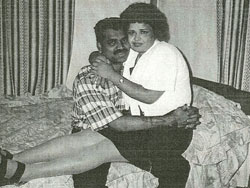
Just married - Madhavi and herformer husband, Kumar
Kumar
could also be deported should Immigration Canada pick up this case and
investigate.
Prior
to this case "the fact that the husband had an improper motive for
marriage, or was not as suitable a candidate as the wife had thought, has
never been a ground for invalidating the marriage, or for awarding
damages," Justice Edwards wrote.
"All
our evidence established that her estranged husband falsely represented
his intention to marry her, falsely represented his intention to stay
married to her and falsely represented his intention to build a family
with her in Canada," said Raju’s lawyer, John McGreevy
"The
defendant was unable to explain his behavior, why he left her immediately
after arriving in Canada," he said.
Richard
Kurland, a Vancouver-based immigration specialist said the decision has
established a precedent.
"Prior
to this decision the generally accepted view of the law was that a spouse
had no right to sue her husband under common law for any tort, including
deceit," he said.
"If
upheld as law, jilted sponsors should have a remedy against spouses in
cases of marriages of immigration convenience," he said.
In
an interview with The Asian Pacific Post after the decision, Raju
said winning the case was "a relief for me."
She
said her husband, whom she is still technically married to, used her to
come to Canada.
"He
lied to me from day one…his intention was to get rid of me…he cheated
on me," said Raju.
Raju
said she loved her husband. "It hurt me when he left me."
Kumar
has filed for a divorce but Raju is in no rush to grant him that.
Her
priority is to get the money awarded by the court first and after that she
is prepared to grant him a divorce and move on with her life, said her
lawyer, McGreevy.
Raju,
a Canadian citizen of Fijian origin, was a self-supporting, childless, 41
year old divorcee when she married Kumar, a 29 year old divorcee with one
daughter in Fiji on June 13, 1999.
Kumar
a Fijian citizen had never been abroad.
The
couple was introduced to each other two months earlier through family
connections. They corresponded and spoke by telephone a few times before
Raju flew to Fiji in June 1999 to meet Kumar personally.
Both
testified each had told the other there could be no agreement to marry
until they had met face-to-face.
According
to Raju, they discussed their mutual desire to have children and Kumar
expressed a desire to live in Canada.
Raju
purchased engagement and wedding saris in Canada which she took with her
to Fiji anticipating her marriage. She also took Canadian immigration
forms necessary for the defendant to obtain landed immigrant status so he
could live with her in Canada.
When
Raju arrived in Fiji, she met Kumar two or three times for a few hours.
With the assurance of her father that Kumar was a suitable man of the
proper caste, she agreed to the marriage at a family meeting.
The
court heard that before the marriage, Kumar told Raju of his divorce, that
he had a daughter, and that he had split up with his girlfriend a few
months before.
The
couple was wed so soon that there was not even an opportunity for Raju to
wear the sari she had bought for an engagement party.
She
said she bought her husband a wedding ring for $300 and paid $1,000 for
the wedding reception including an album of photos.
After
the wedding Raju returned to Canada, filled in the immigration forms and
submitted them on his behalf in July 1999, paying the requisite $500 fee.
In
November 1999 Raju received an anonymous telephone call from a woman in
Fiji who said "your husband is going to be mine."
In
November 2000 his application for a visa was refused. Raju testified she
was told by immigration officials that her husband could not answer some
questions, failed to mention that he was intending to join her in Canada
and did not give her address.
In
a letter to his wife, Kumar said he did not know what went wrong in the
immigration interview and expressing his continued desire to join her in
Canada "soon."
Raju
filed an immigration appeal on her husband’s behalf and paid the $2500
fee.
She
then started getting more phone calls that her husband was having an
affair with a woman in Fiji.
Raju
flew to Fiji to confront him. He denied the affair in front of local
police.
Kumar
said the woman was pursuing him and that he wanted to stay married to Raju.
But
Raju was suspicious and felt her husband was being unfaithful.
Her
suspicion of infidelity was justified.
During
the trial Kumar admitted he had lied to his wife and resumed his illicit
affair shortly after she returned to Canada from Fiji in January 2001.
At
the same time he continued to write love letters to his wife and she
called him frequently at considerable expense.
In
December 2001, Kumar was allowed to come to Canada after his appeal was
granted.
An
excited Raju paid the $975 landing fee for her husband, took him to her
home and they resumed intimate relations.
After
a few nights this ceased.
According
to Raju, her husband hardly spoke to her and answered "you wouldn’t
understand" when she asked why.
He
refused to go to work and become angry when Raju who returned home from
work questioned the messy house.
The
marriage quickly deteriorated.
In
January 2002, Kumar vanished.
He
had flown to Edmonton where he resided with relatives and got a job.
Within a few days of arriving there he contacted his lover in Fiji and
began to write love letters to her.
For
nine months until September 2002 Raju tried to locate her husband.
She
spent over $8,000 on long distance telephone calls and was also bilked of
her jewellery by a psychic she engaged to help find her husband.
Eventually
Raju found her husband in Edmonton and when she telephoned him, he told
her he did not want to speak to her and that she should not call again.
Raju was devastated.
On
January 27, 2003, Kumar petitioned for divorce from Raju in Alberta.
Justice
Edwards said Kumar’s lack of commitment to the marriage was evident
almost immediately upon his arrival in Canada.
He
awarded Raju $1,300 for marriage expenses including the cost of the
wedding reception and ring, $3,475 for immigration application expenses
and special damages of $11, 376.
The
judge also awarded Raju $10,000 general damages for hurt feelings,
humiliation, inconvenience and postponement of the opportunity to marry
another man while she was still capable of bearing children
"I
make no award of punitive damages. While the defendant’s conduct was
that of a cad, courts are reluctant to censure even the most egregious
marital conduct, since to do so may promote vindictive and extortionate
litigation," the judge added.
